
Most companies talk about being AI-first. David A. Steinberg has been doing it since 2017.
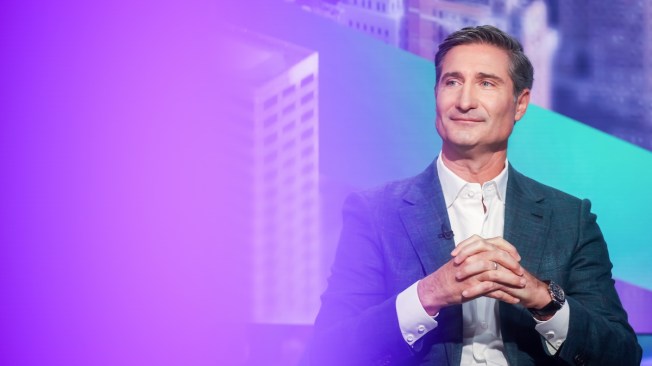
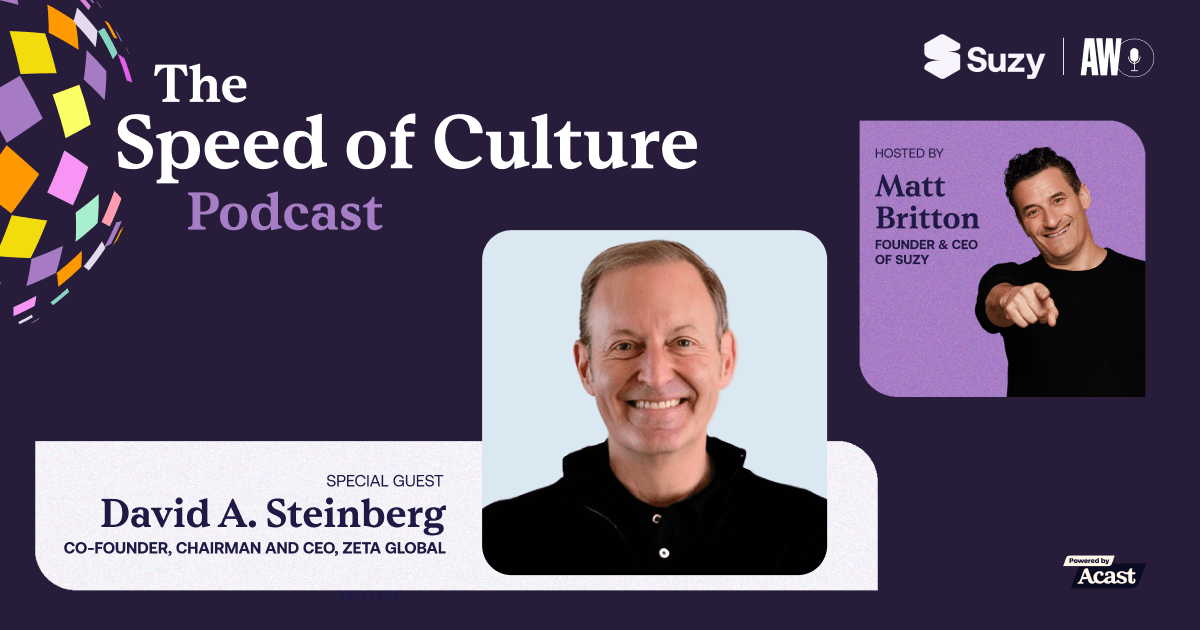
In this episode of The Speed of Culture podcast, Matt Britton sits down with David A. Steinberg, co-founder, chairman and CEO of Zeta Global.
David shares how Zeta built a data and AI platform that now serves 51% of the Fortune 100, why the company sees itself as the disruptor rather than the disrupted in a rapidly shifting martech landscape, and what it took to rearchitect the business around artificial intelligence starting in 2017.
The conversation covers the launch of Athena, Zeta’s voice-enabled AI copilot built in partnership with OpenAI, the internal transformation required to make AI native to the way teams work, and what the rise of generative search means for how brands reach consumers.
David also reflects on his career, his advice for the next generation of marketers, and the mantra he has carried through every crisis.
A serial entrepreneur, David previously founded four telecom companies, selling three and taking one public, before pivoting into data-driven marketing.
At Zeta, he has spent nearly two decades building what he describes as the infrastructure for the inference generation of AI: a platform with 552 million opted-in individuals in its data cloud, an average of 5,000 to 7,000 data elements per person, and a first-party tracking pixel sitting on trillions of pages of content.
The company recently launched Athena, a fully conversational AI copilot built in partnership with OpenAI, and has projected its fourth consecutive year of over 30% growth heading into 2026.
Key Takeaways:
[01:54] How David Reads the Market and Why Triangulation Matters — David’s approach to identifying where to build next is not a gut call. He describes spending five to six hours a day reading across publications, white papers, and scientific journals, looking for signals in seemingly unrelated data points that point toward something real. He calls it triangulation. With Zeta, that process led him to a simple but consequential observation in 2017: there was no way to process the volume of data they were ingesting fast enough to make a decision that actually mattered. That gap became the founding logic for putting AI at the center of the platform, years before it was an industry conversation.
[06:30] Why Zeta Is the Disruptor, Not the Disrupted — As the broader marketing technology category grew around 10 percent last year, Zeta grew 30 percent. David’s explanation for why the company has been insulated from the disruption hitting so many SaaS businesses comes down to a few compounding advantages: a proprietary data cloud that has never been fed into a large language model and never will be, an architecture that puts AI and data native to the application layer rather than bolted on, and a revenue model that returns six to seven dollars for every dollar a client spends. Those three things together make Zeta a revenue center rather than a cost center for its clients, which is a fundamentally different conversation to have in a procurement meeting.
[11:57] Building Athena and the Case for Voice-First AI — The idea behind Athena, Zeta’s voice-enabled AI copilot, starts with an observation about human history. For hundreds of thousands of years, people communicated through voice. The keyboard arrived in the 1950s. David’s argument is that removing the friction between a person and the AI means returning to the most natural form of communication we have. Athena can be interrupted mid-thought, is fully conversational, and is integrated with ChatGPT so clients can move between platforms without losing context. When Zeta’s earlier voice tool Zoe was launched, clients using it spent 250 to 275 percent more on the platform than those who did not. That data point gave the team confidence to go into full build mode on Athena.
[16:33] What an Internal AI Transformation Actually Looks Like — David is candid about what it took to bring the organization along. Rather than mandating adoption or calling out employees who were slow to change, the team publicly recognized the people who were using AI tools well and asked them to share how it was improving their work. Engineers were organized into pods, with the best AI-native talent placed in charge of leading them over. The result: engineering output is now at 125 percent of where it was twelve months ago on a net basis. David is also direct about the fact that some employees who did not embrace the shift were moved on, and that the company is doubling down on those who did.
[25:39] What the Rise of AI Search Means for Consumer Reach — A year ago, 97 percent of Google searches resulted in a link off the platform. Today, 60 percent of answers are resolved on the platform itself. David sees this as a structural shift with real implications for how brands reach consumers, and Zeta has already built a generative engine optimization platform to help clients get ingested into AI-generated answers across OpenAI, Claude, and Gemini. He also notes that as Google and Meta continue to dominate digital spend, clients are hitting diminishing marginal returns, and the question of where else to put the budget is becoming more urgent. The OpenAI ads partnership positions Zeta to be part of that answer.
[31:40] Never Waste a Crisis — The mantra David comes back to is one he traces to Machiavelli: never let a crisis go to waste. He used COVID as the most concrete example. While others were scrambling, Zeta had already seen signals in Japan and moved fast, rearchitecting global operations for remote work, securing housing for employees in Hyderabad, and purchasing Chromebooks for hundreds of people before lockdowns arrived. The company grew that year while competitors shrank. His point is not that crises are lucky. It is that in the middle of one, the opportunity cost of change is at its lowest, which makes it the best possible time to do the hard things that would otherwise get deferred indefinitely.